
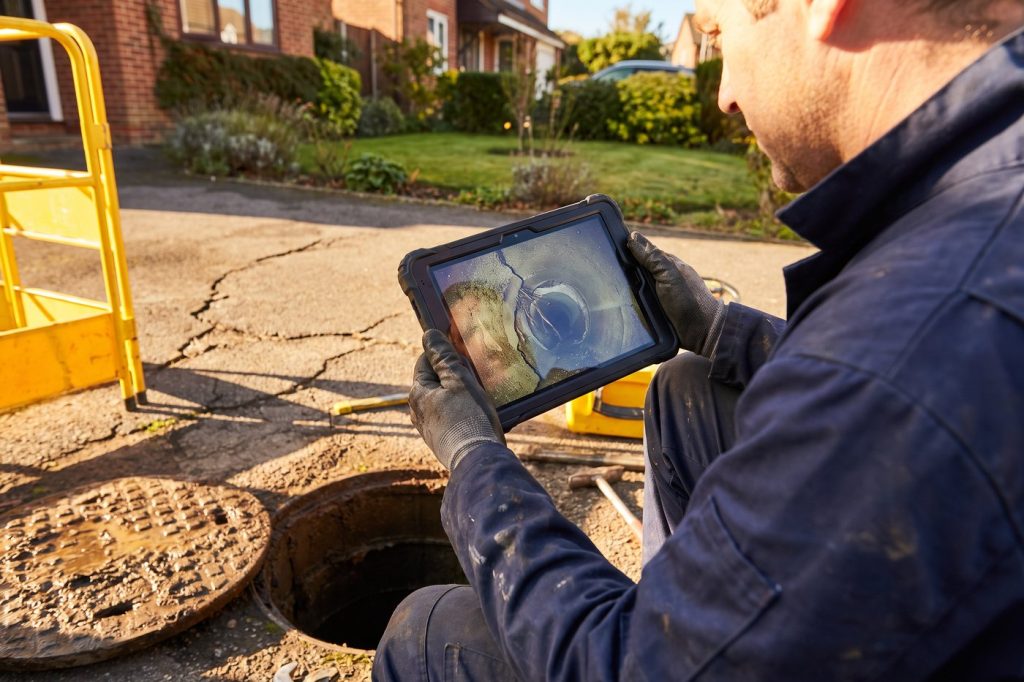
A CCTV drain survey puts a camera through your drains and shows exactly what is inside them: blockages, cracks, displaced joints, root intrusion, scale, and sections holding water. You get a written report with a layout plan, a run by run log, still images of every defect, the video footage and graded recommendations, so you know precisely what needs fixing, where it is, and what can safely be left alone.
Drains fail out of sight, which is what makes them stressful: you can see the symptom, a blockage or a smell or a damp patch, but not the cause. A CCTV drain survey removes the guesswork. This guide explains what the camera actually sees, what happens on the day, and then walks through a typical survey report section by section, so that when one lands in your inbox you can read it with confidence rather than skipping to the price at the end.
On this page
What the camera actually shows
The camera is a small, waterproof, self-lit unit on the end of a flexible push rod (or a motorised crawler for larger pipes), and it sends live footage back to a monitor as the engineer works it along each drain run. Because it travels the full length of the pipe, nothing between the chambers is hidden from it.

In practice, a survey identifies things in four broad groups. First, blockages and build-up: what is obstructing the pipe, whether that is compacted fat, wipes, scale, silt or debris, and how much of the bore it has taken. Second, structural condition: cracks, fractures, displaced or open joints, deformed sections in older pitch fibre pipes, and in the worst cases partial collapse. Third, intrusions and connections: tree roots that have found their way in through a joint, badly made connections from later building work, and any interceptor traps or junctions the system has. Fourth, the geometry of the system itself: pipe material and diameter, the direction each run flows, and sections that hold standing water, which usually indicates a belly or back-fall in the pipe. Crucially, the equipment records how far along the run each observation sits, and a sonde on the camera head can be traced from the surface, so a defect is located to a point you could mark on the lawn, not just somewhere under the garden.
What happens on the day
A domestic survey is straightforward and non-invasive; nothing is dug up. The engineer starts by lifting the available access points, usually manhole covers and inspection chambers, to map how the system is arranged. If the drains are heavily fouled, they may need a clean first, because a camera cannot report on a pipe wall it cannot see; this is why survey and jetting equipment often travel on the same van. The camera is then fed along each run in turn while the engineer watches the live picture, notes each observation and its distance, and captures still images of anything significant. A typical house takes around one to two hours on site depending on the number of runs and how accessible the chambers are. You are welcome to watch the monitor as it happens, and a good engineer will talk you through what you are looking at in plain English.
The report, section by section
The footage is only half the product. The report is what you keep, act on, and, where relevant, show a solicitor, insurer or seller. Formats vary between firms, but a proper survey report walks through the same core sections.
| Report section | What it tells you |
|---|---|
| Summary of findings | The plain English verdict: overall condition, the significant defects, and what needs doing. |
| Site and drainage plan | A sketch or plan of the runs surveyed, chambers, flow directions and where each defect sits. |
| Run by run log | Every observation in order, with its distance along the pipe from the start point. |
| Defect images | A still photograph of each defect, captioned with what it is and where it is. |
| Video footage | The full recorded survey, usually supplied as digital files or a link. |
| Gradings and recommendations | How serious each defect is and the recommended remedial action, if any. |
The summary
Read this first. It should state, without jargon, whether the system is fundamentally sound, which defects matter, and what the surveyor recommends. If a report's summary does not commit to a view, ask the firm to explain their findings until it does.
The plan and the run log
The plan turns an invisible network into a picture: which chamber connects to which, where the runs pass under the drive or the extension, and where the system meets the public sewer. The log then records the camera's journey along each run, observation by observation. Entries are typically coded to the industry standard classification used across the UK drainage trade, with each code translated in the report, and each entry carries a distance, which is what makes a targeted repair possible: a fracture logged at a known distance along a known run is a point on the ground, not a mystery.
Images, footage and recommendations
The stills are your evidence, and they matter beyond the survey itself: a homebuyer can put them in front of a seller, and an insurer will expect them with a claim. The recommendations section closes the loop by matching each significant defect to a proportionate fix, whether that is jetting and a re-inspection, a localised lining repair, or an excavation as the last resort. A trustworthy report will also say, plainly, when something needs no action at all.
How defects are graded
Not every defect in a drain is a problem, and this is where a graded report earns its keep. UK surveys grade what they find on a scale from sound to failed, separating service condition, how well the drain carries flow, from structural condition, the state of the pipe itself. A hairline crack in an otherwise sound clay pipe may be graded as minor and simply noted for monitoring. Heavy root intrusion or a badly displaced joint sits at the serious end and comes with a recommendation attached. The grading is your protection against both extremes of bad advice: it stops a cosmetic blemish being sold to you as an urgent excavation, and it stops a genuine structural fault being dismissed as nothing. If you receive a survey report from any firm and the defects are not graded, treat the recommendations with caution.
When a survey is worth having
Three situations account for most of the surveys we carry out. The first is a recurring blockage: a drain that keeps blocking has a cause, and the camera finds it, which is the difference between paying for clearance after clearance and paying once for the right fix. Our guide to why drains keep blocking covers the usual suspects. The second is buying a property, because standard home surveys do not look inside the drains and drainage faults are expensive to inherit; see our guide to a homebuyer drain survey for how that works. The third is evidence: for an insurance claim, a dispute over responsibility, or before and after building work near drainage. In each case the survey output is the same, a recorded, graded, located account of the system's condition. For what the inspection itself typically costs, our CCTV drain survey cost guide gives honest figures, and the CCTV drain survey service page covers how to book one. Where the survey does find damage that needs fixing, the report feeds straight into a targeted drain repair rather than exploratory digging.
Frequently asked questions
What does a CCTV drain survey show?
A CCTV drain survey shows the inside of your drains in real time: blockages and what they are made of, cracks and fractures, displaced or open joints, root intrusion, scale and fat build-up, bellied or back-falling sections, and the pipe material, size and layout. It also pinpoints where each problem sits, both by distance along the pipe and depth.
How long does a CCTV drain survey take?
A typical domestic survey takes around one to two hours on site, depending on how many runs the property has, how accessible the chambers are, and whether the drains need a clean before the camera can see properly. Larger properties and commercial systems take longer. The written report usually follows within a few working days.
What is in a CCTV drain survey report?
A proper report contains a summary of findings, a plan or sketch of the drainage layout, a run by run log of every observation with its distance along the pipe, still images of each defect, the recorded video footage, defect gradings that separate cosmetic issues from structural ones, and clear recommendations for any work needed.
Will a drain survey find the cause of a recurring blockage?
Yes, that is one of its main jobs. A drain that keeps blocking has an underlying cause, such as roots, a dropped joint, scale or a belly holding waste. The camera shows exactly which it is and exactly where, so the fix can be targeted at one point rather than guessed at.
Is a CCTV drain survey worth it when buying a house?
Usually, yes. Standard home surveys do not look inside the drains, and drainage faults are among the more expensive hidden problems a property can have. A pre-purchase drain survey shows the true condition of the system before you commit, and the report can support renegotiation if it finds significant defects.
Want to know what is really going on in your drains?
We carry out CCTV drain surveys across Plymouth, south east Cornwall and south and west Devon, with a full written report, images, footage and plain English recommendations. Fixed price agreed before we start.
Call DCI Drainage on 07418 000 420 Fast, free quotes · Local, independent, not a franchise


