
Rats get into drains through defects in the pipework: cracks, open joints, uncapped redundant pipes or broken traps that connect your private drain to the sewer they live in. Signs include night time scratching, droppings, smear marks and holes near drain runs. Poison alone never lasts, because new rats keep arriving. The permanent fix is a CCTV survey to find the defect, a repair, and a one way rat valve.
Hearing scratching under the floor at night, or finding droppings by a drain cover, is unsettling in a way few household problems match. The important thing to understand is that rats in your drains are almost never bad luck. They are a symptom of a fault in the pipework, because a sound, sealed drainage system gives a rat no way out of the sewer. This guide covers how they get in, how to tell whether yours are using the drains, whose job it is to deal with them, and the fix that actually stops them rather than thinning them out for a month.
On this page
How rats get into drains
Brown rats are at home in sewers. They swim well, climb vertical pipes, and can squeeze through surprisingly small gaps. The public sewer network is their motorway, and your private drain is the slip road to your property. While that slip road is sealed, they pass by. The trouble starts when a defect opens a junction between the pipe and the ground around it, or between the drain and your building.

The usual entry points we find on camera are:
- Cracked or collapsed sections of pipe, which let rats burrow out of the drain and up through the soil towards buildings.
- Open or displaced joints, common in older clay pipework where ground movement has pulled sections apart.
- Redundant pipes that were never capped, often left over from a removed outside toilet, an old extension or a demolished outbuilding. An open ended pipe is an open door.
- Broken or missing interceptor traps in Victorian and Edwardian systems, which were designed precisely to keep sewer rats out and often fail with age.
- Poorly sealed connections where a new extension or conservatory was tied into the existing drain.
Once out of the pipe, rats follow the warm voids: cavity walls, under floor spaces, and the loose backfill alongside drain runs. In rare but memorable cases they come up the other way, surfacing through the toilet pan itself.
Signs of rats in your drains
No single sign is proof, but a cluster of them points strongly at the drains as the route in.
| Sign | What it suggests |
|---|---|
| Scratching or scurrying at night, under floors or in walls | Rats moving through voids, often having entered low down near a drain defect. |
| Droppings near drain covers, gullies or in outbuildings | Dark, spindle shaped droppings about the size of a raisin indicate regular traffic. |
| Greasy smear marks along pipes and skirting | Rats follow the same runs repeatedly and their fur leaves oily marks. |
| Holes or sunken ground appearing near a drain run | Burrowing out of a broken pipe displaces soil; subsidence over a drain also suggests a collapsed section. |
| Gnaw marks on plastic pipes, cables or joists | Rats gnaw constantly; damage clustered near pipework is telling. |
| A persistent musky or ammonia smell | An established nest or well used run nearby. |
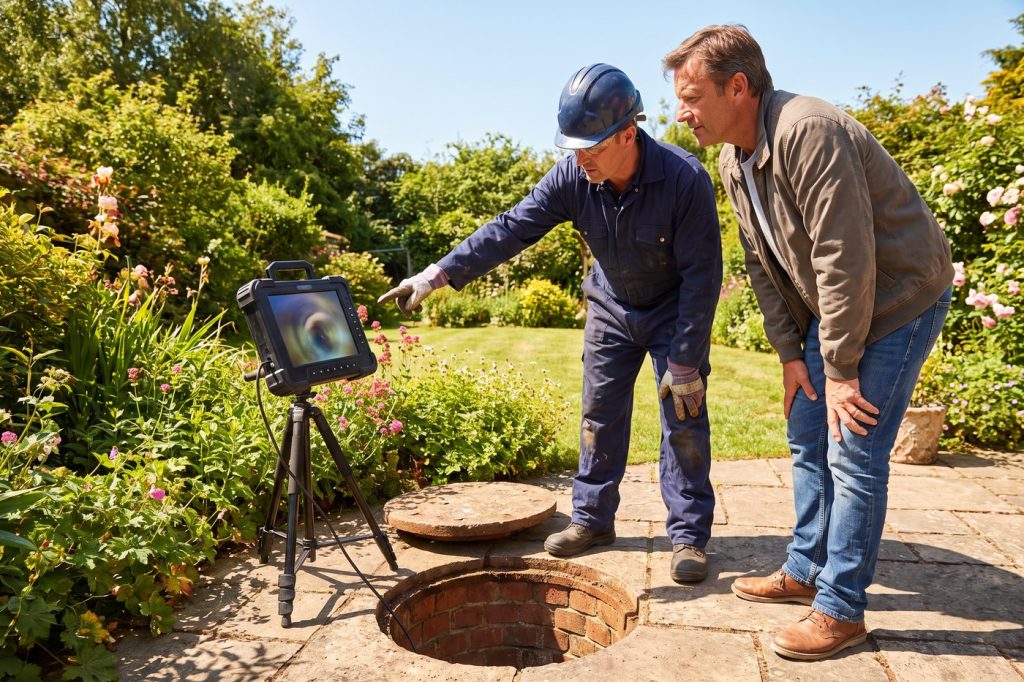
The confirmation step is a CCTV drain survey. A camera through the system shows the defects, the droppings and smear marks inside the pipe, and often the rats themselves, so you know exactly where the entry point is rather than guessing at it with bait boxes.
Who is responsible for rats in drains?
Responsibility follows the pipework, and the rule is the same as for any blocked drain. Drains that serve only your property, within your boundary, are private drains and they are yours, so a defect letting rats in through one of those is yours to repair. Where pipes are shared between properties, or run beyond your boundary on their way to the sewer, they are usually lateral drains or public sewers, and those belong to South West Water across Cornwall and Devon. If a camera survey shows the defect is in their pipework, report it to them with the survey evidence.
The local council sits slightly to one side of this. Councils have pest control duties and some offer treatment services, but they do not repair private drains, so calling the council about rats will at best deal with the animals currently on your land, not the doorway they came through. Landlords are generally responsible for the structure and drainage of a rented property, so tenants with drain rats should report them in writing. The boundaries question has more wrinkles than most people expect, and our guide to blocked drain responsibility explains how to work out which pipes are whose.
How to stop them for good
There is a reason rats come back after every round of poison: baiting treats the population, not the route. The sewer holds an effectively unlimited supply of replacements, so while the defect exists, so does the problem. The lasting fix has three parts.
1. Find the entry point on camera
A CCTV survey traces every run on the property, maps the system, and records the defects: the open joint, the uncapped stub, the broken trap. This is the step that turns "we think they are coming from the drains" into a specific repair at a specific point.
2. Repair the defect
Depending on what the camera finds, the fix might be capping a redundant pipe, resealing a joint, relining a cracked section from inside without digging, or excavating and replacing a collapsed length. A targeted drain repair closes the door permanently, and fixing the defect usually resolves other symptoms at the same time, such as recurring blockages or a lingering smell.
3. Fit a one way rat valve where appropriate
A rat valve, sometimes called a rat blocker or flap, is a stainless steel one way gate fitted inside the drain, usually at the boundary chamber. Water and waste flow out freely, but the flap stops anything travelling up the pipe towards the property. Fitted after the repair, it protects the whole private system against the sewer population, which matters on older properties where more defects may develop over time.
Dealing with any rats already inside the building is then a job for a pest controller, and it is worth doing in that order. Sealing the drain first means the treatment is clearing a finite number of animals rather than bailing a boat with the hole still open.
Keeping them out afterwards
Once the drain is sealed, a little housekeeping keeps the property unattractive to the next scouting rat. Keep drain covers and gully grates intact and seated, cap any disused pipe you uncover during garden or building work, avoid putting food waste down external gullies, and store bin bags off the ground. If you have had rats once, a periodic camera check of the system is cheap reassurance, especially on older clay pipework where new defects can open as the ground moves.
Frequently asked questions
Can rats really get into your house through the drains?
Yes. Rats live and travel in sewer systems, and a defect in your private drain, such as a cracked pipe, an open joint, a redundant pipe that was never capped, or a broken interceptor trap, gives them a route out of the sewer and towards your home. They are strong swimmers and can climb vertical pipes, and in rare cases they surface through toilets.
Who is responsible for rats in the drains?
It depends where the defect letting them in sits. Drains serving only your property within your boundary are yours, so a fault there is yours to repair. Shared drains and pipes beyond your boundary are usually lateral drains or public sewers, which belong to the water company, South West Water in Cornwall and Devon. Local councils deal with rat infestations on land, but not with repairing private drains.
How do I know if the scratching I can hear is rats in the drains?
Common signs include scratching or scurrying under floors or behind walls at night, droppings near drain covers or in outbuildings, greasy smear marks along pipe runs, gnaw damage, disturbed soil or holes appearing near drain runs, and a persistent musky smell. The only way to confirm drains are the route is a CCTV drain survey, which finds both the rats' runs and the defect they are using.
Will poison alone get rid of rats in drains?
Not for long. Baiting kills individual rats but the sewer population is constant, so while the entry defect exists new rats keep arriving. The lasting fix is to find the defect with a camera survey, repair it, and where appropriate fit a one way rat valve so anything in the pipe can leave but nothing can come back up.
Hearing scratching? Let a camera settle it
We run CCTV rat surveys across Plymouth, south east Cornwall and south and west Devon, find the exact entry point, and quote a fixed price to seal it, including one way rat valves. No guesswork, no endless bait boxes.
Call DCI Drainage on 07418 000 420 Fast, free quotes · Local, independent, not a franchise


