
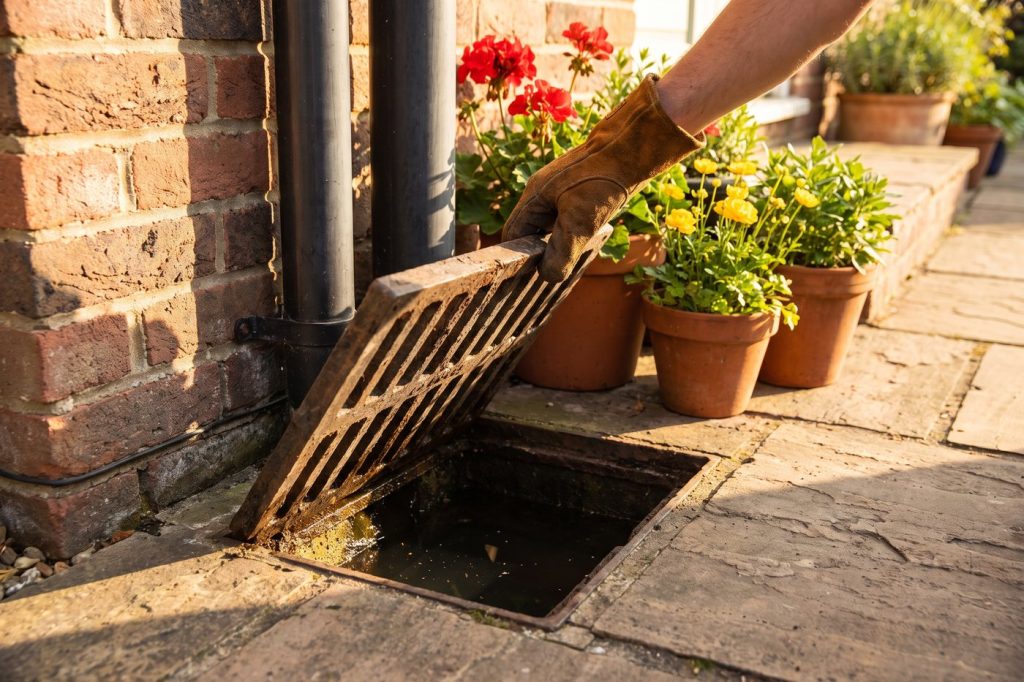
A gully is the small outside drain at ground level, usually covered by a grate, that collects rainwater and waste water from your gutters, sinks and appliances and carries it into the underground drains. Most gullies hold a water trap that stops drain smells escaping. When a gully overflows, either the gully pot is blocked or the pipe below it is.
Walk around almost any home in Cornwall or Devon and you will find at least one gully: a modest grated opening sitting below a downpipe, outside the kitchen wall, or in a corner of the yard. Most people never give it a thought until it overflows in a downpour. This guide explains what a gully actually does, the types you are likely to find outside your own house, why gullies block, how to clean one yourself, and how to tell when an overflowing gully is really a symptom of a blocked drain further down the line.
On this page
What a gully is and what it does
A gully is a fitting that connects surface-level water to your underground drainage. It has three jobs. First, it collects: rainwater from a downpipe, waste water from a kitchen sink or washing machine pipe, or run-off from a paved area all discharge into it. Second, it filters: the grate on top keeps leaves, litter and larger debris out of the drain, and the pot below catches silt and grit before they travel down the pipe. Third, in most designs, it seals: a bend of standing water inside the gully, called a trap, sits between your home and the drains so that smells and sewer gases cannot escape into your garden or through an open window.

That water seal is why a healthy gully has water sitting in it. People sometimes peer through the grate, see standing water and assume the drain is blocked. A few inches of clear water in the bottom of the pot is normal and correct. The problem signs are different: water rising to the top and pooling around the grate, water that drains away very slowly after rain, or a smell where there was none before.
The types of gully outside your home
The gullies around a typical property in Plymouth, south east Cornwall or Devon fall into a few common designs, and knowing which one you have makes cleaning and diagnosis much easier.
| Type | How to recognise it | What it usually serves |
|---|---|---|
| Trapped gully | Grated opening with standing water visible in the pot below | Foul or combined drains taking kitchen and appliance waste; the trap blocks smells |
| Untrapped gully | Straight drop with no standing water | Surface water only, usually rainwater from paving or a downpipe |
| Bottle gully | Modern plastic unit, often square topped, with a removable inner sleeve | New builds and replacements; easy to lift out and rinse clean |
| Back inlet gully | Pipes enter through the side or back, below the grate | Downpipes and waste pipes plumbed directly in, tidier and less prone to splashing |
| Roadside gully | Heavy metal grate set into the road or kerb | Highway drainage; belongs to the council, not the homeowner |
Older cottages and terraces around this patch often have Victorian-era ceramic gullies with a shallow dish top, while post-war and modern homes tend towards plastic bottle gullies. Both do the same job; the older ones simply have more years of silt behind them and mortar joints that can fail.
Why gullies block
Because a gully is the first line of defence for the drain, it collects everything the drain should not have to deal with, and that is exactly why it blocks. The usual culprits are:
- Leaves and moss. The biggest cause in autumn, especially under trees or where moss washes off a roof into the downpipe.
- Silt and grit. Washed off paving and out of gutters, it settles in the pot until the trap chokes.
- Fat and food waste. Kitchen gullies slowly coat themselves in grease, which then binds everything else together.
- Soil and plant growth. Gullies at lawn edges gather soil, and it is surprisingly common to find weeds growing happily in a neglected pot.
- Rendering and building debris. After any outside building work, washed-out mortar and render find their way to the nearest gully and set hard.
An overflowing gully rarely announces itself politely. In heavy Cornish rain, a blocked gully sends water sheeting across the yard, into airbricks, or against the base of a wall, and persistent overflow against a wall is a classic starting point for damp inside the house.
How to clean a gully yourself
Cleaning a gully is one of the most genuinely worthwhile DIY drainage jobs, and most people can do it in fifteen minutes. Put on rubber gloves, and ideally eye protection if you will be flushing with a hose.
- 1. Lift the grate. Most lift straight out or unscrew. If it is corroded in place, ease it up with a flat screwdriver rather than forcing it.
- 2. Scoop out the pot. Remove leaves, silt and sludge by hand or with a small trowel until you reach clear water. A bottle gully lets you lift the whole inner sleeve out and rinse it.
- 3. Flush it through. Run a hose or pour a couple of buckets of water in. It should drain away briskly and the trap should refill and hold water.
- 4. Refit the grate. A missing or broken grate is worth replacing for a few pounds, because it is the only thing keeping the next lot of leaves out.
Doing this once or twice a year, ideally after autumn leaf fall and again in spring, prevents the majority of gully blockages. If several gullies, a long run of pipe or an older system need regular attention, a scheduled professional drain cleaning and maintenance visit keeps the whole system clear without you thinking about it.
When a blocked gully means a bigger problem
Here is the important distinction. If you clean the pot out and water still backs up, the blockage is not in the gully at all. It is downstream, in the underground pipe the gully feeds. Debris that got past a broken grate, fat that built up along the run, or root intrusion further down will all show up first as a gully that will not drain no matter how clean the pot is.
That is the point where DIY stops being productive. A blockage in the buried run needs rodding or high pressure jetting to clear properly, which is professional drain unblocking territory. And if the same gully backs up repeatedly even after the run has been cleared, something in the pipe is causing it, and our guide on why drains keep blocking explains what tends to be behind that and how a camera survey pins it down.
Whose gully is it anyway?
A quick word on responsibility, because it decides who pays. A gully within your boundary that serves only your property is yours to maintain and unblock. The heavy grated gullies in the road are highway drains and belong to the council, so a flooded street grate is a report to the local highways team, not a bill for you. And where the pipework beyond your gully joins a shared or public sewer past your boundary, responsibility usually passes to the water company, which in this patch is South West Water. If you are not sure which side of the line your problem sits, a decent local engineer will tell you honestly before any money changes hands.
Frequently asked questions
What is a gully drain?
A gully is the small outside drain, usually a grated opening at ground level, that collects rainwater and waste water from pipes above it and carries it into your underground drainage system. Most have a water trap inside that stops smells escaping from the drains below.
Why does my gully keep overflowing?
Either the gully itself is blocked with leaves, silt, fat or debris, or the underground drain it feeds is blocked further along so water has nowhere to go. If clearing the gully pot does not fix it, the blockage is downstream in the pipe and usually needs rodding or jetting to shift.
Who is responsible for a blocked gully?
A gully on your property serving only your home is your responsibility. Roadside gullies in the street belong to the local highways authority. If a blockage sits beyond your boundary in a shared or public sewer, South West Water is usually responsible in this area.
How often should a gully be cleaned?
Once or twice a year is enough for most homes. Do it in autumn after leaf fall and again in spring. Gullies near trees, on kitchen waste runs or in exposed coastal spots may need checking more often because leaves, fat and wind-blown debris build up faster.
Gully overflowing and cleaning it has not fixed it?
Then the blockage is in the pipe, and that is our job. We clear blocked gullies and drains across Plymouth, south east Cornwall and south and west Devon, with a straight fixed price agreed before we start.
Call DCI Drainage on 07418 000 420 Fast, free quotes · Local, independent, not a franchise


